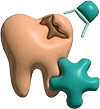
Black spots on teeth are dark-colored changes that appear on the tooth surface or within the tooth structure. These discolorations—which may appear black, dark brown, or in the form of spots—do not always stem from the same cause. While some result from pigments accumulated on the tooth surface from tea, coffee, and tobacco, other black areas may be related to tooth decay, tartar, or color changes within the tooth’s internal structure.
Therefore, it is incorrect to assume that every black spot on a tooth is a cavity, just as it is incorrect to dismiss every black stain as merely a superficial discoloration. In particular, dark-colored areas that have recently appeared, are growing, or are accompanied by tooth sensitivity or pain should be evaluated by a dentist.
Superficial stains on teeth can be reduced or removed through professional procedures such as tartar removal and polishing. However, if decay lies beneath the black appearance, simply removing the stain is not sufficient; the decay must be properly treated. Similarly, the treatment approach for color changes originating from the tooth’s internal structure differs from that used for superficial stains.
Therefore, how to remove black stains on teeth depends primarily on the cause of the stain.